Brand Profile
What assistants say when asked about you by name: recognition, sentiment and the themes behind it.
The Brand Profile is built from questions about you by name, such as "What do you know about Acme?" or "Would you recommend Acme?" — if Acme is your brand. The metrics on this page are explained in detail on Brand Profile metrics.
Brand-profile prompts
The page is fed by the prompts in your brand-profile topics — questions that name your brand. We suggest a set when you start, and you can edit them or add your own. These prompts are kept out of AI visibility, share of voice and position, because a question naming you would always produce an answer that "mentions" you.
Results summary
The page opens with a one-sentence summary of your results — how assistants speak about you, the theme they hesitate on most, and how many answers didn't recognise you — and a status (from 5 answers):
| Status | What it means |
|---|---|
| At risk | Negatives outweigh positives in what assistants say — sentiment below 45 |
| Low recognition | A meaningful share of answers don't know the brand — recognition below 75% |
| Mixed signals | Sentiment of 45–65, or 66–79 with hesitation on at least one theme |
| Strong sentiment | Assistants speak well of you and know who you are — none of the above |
| Still collecting | Not enough answers yet |
Next to it: the sentiment score, recognition, the mix of positive, neutral and negative answers, and a recent activity strip showing negative answers in the last 7 days of the selected period compared with the 7 days before.
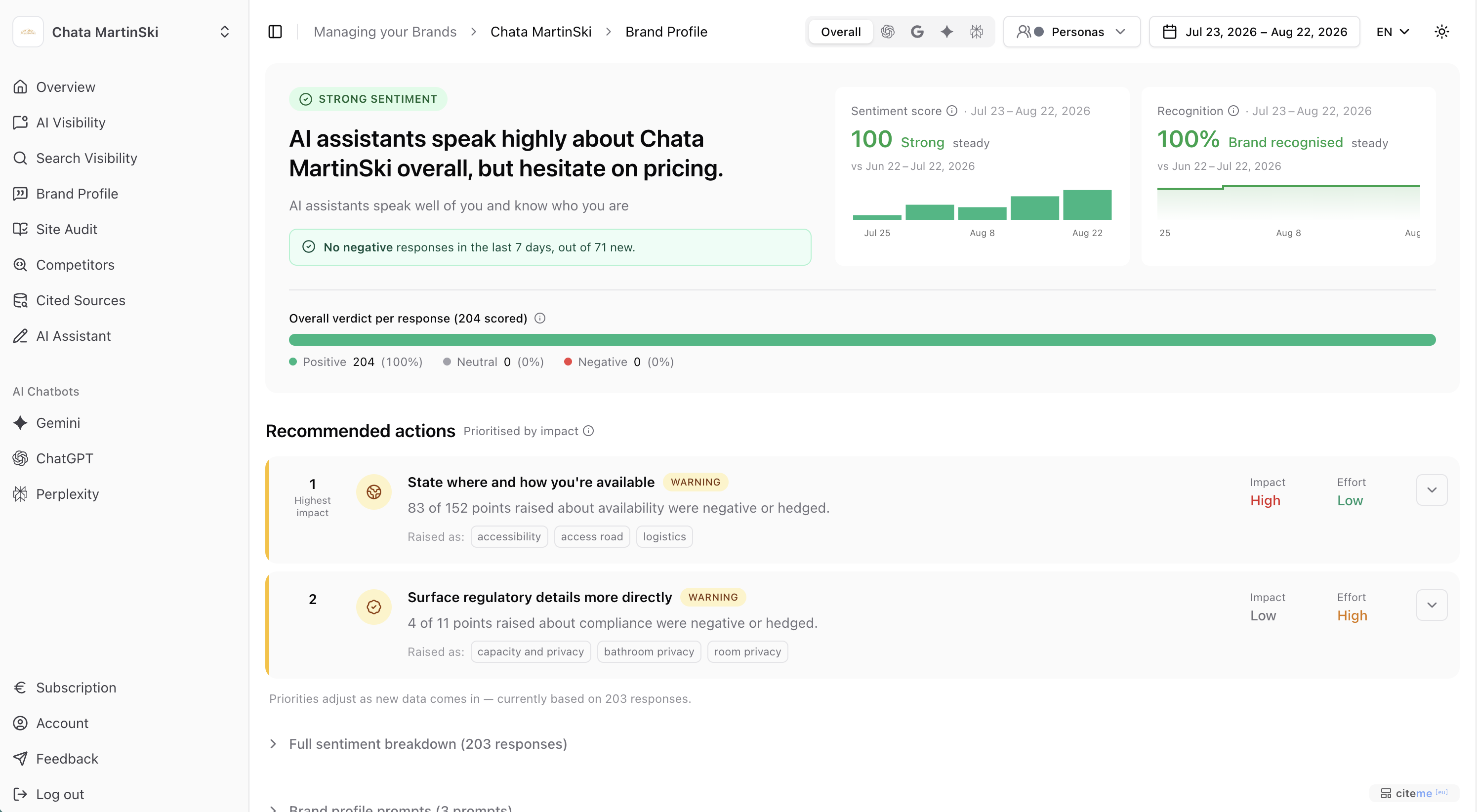 The results summary on the Brand Profile page
How to read the example above:
- Summary — Chata MartinSki has the status Strong sentiment: assistants speak highly of it overall, and hesitate most on pricing.
- The green box shows recent activity — here no negative responses out of 71 new ones. When negative responses appear, the box says so.
- The sentiment score (100, Strong) is the average across answers. Each answer counts half for its overall verdict and half for how much of what it says about you is positive. A score of 100 means the answers were positive and raised no criticism of you. Recognition (100%) is the share of answers that knew the brand. Both show the change against the previous period and a trend chart.
- Overall verdict per response splits the scored responses into positive, neutral and negative — here all 204 are positive.
- Recommended actions are ranked by impact. Each shows how many points about the theme were negative or hedged, how the assistants phrased them (Raised as), and the estimated impact and effort.
- Full sentiment breakdown below the actions expands into sentiment by theme.
Every response is positive, yet the page still recommends actions: a response can be positive overall and still make a negative point, for example about availability.
Sentiment by theme
Each answer is split into the individual points it makes, and each point is assigned to a theme — trust, pricing, features, identity, audience, compliance, support, availability, awareness or other. For every theme you see how many points were positive, neutral and negative, and you can read the exact sentences they came from. See Sentiment themes.
Other brands and top cited sources
- Other brands mentioned — brands assistants name when asked about you. When they keep offering alternatives, buyers asking about you are being pointed elsewhere.
- Top cited sources — the pages assistants rely on when they describe you, by category. If none of them is your own site, third parties are speaking for you.
Recommended actions
Findings are turned into ranked actions, each with concrete steps. Examples:
- Address recurring criticism
- Clarify what you offer
- Increase citation footprint
- Compete for the answer, not just the query
- Get your own site into the answer
- Find what one assistant is reading differently
- Sentiment fell this period
- Add more brand questions
Actions are ranked by severity, then by how many answers they affect, with at most one per theme. Mark an action as done and it leaves the list — it comes back if assistants keep raising the same issue.