Overview
The briefing page: where you stand against competitors, what changed and the three things to do next.
The Overview is a briefing, not a dashboard of every number. It answers three questions: where you stand, what changed, and what to do next. It always covers the past three weeks, across all your assistants and search engines. For other date ranges or a single assistant, open the detailed pages.
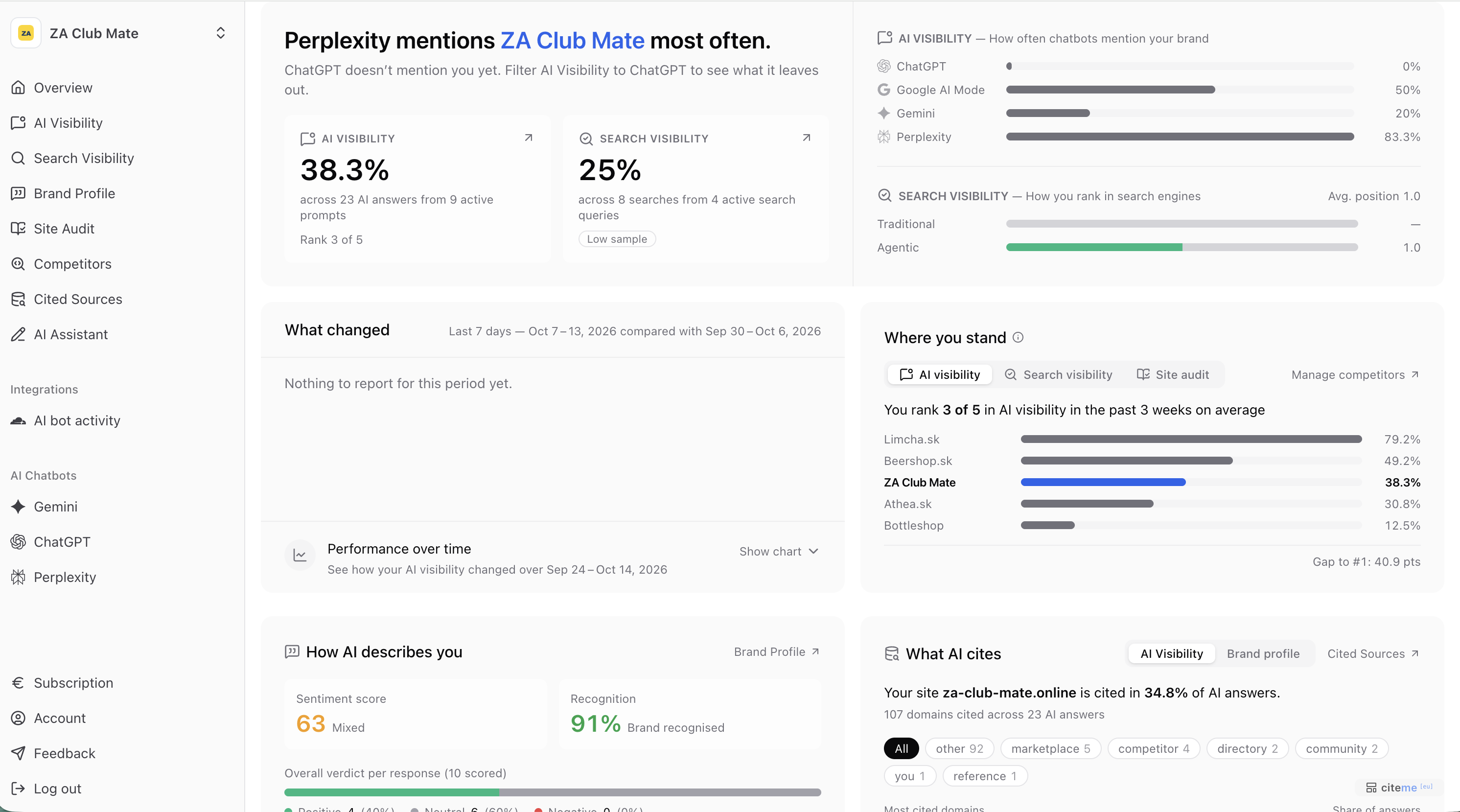 The Overview page
How to read the example above:
- Briefing — ZA Club Mate has the status Visible: AI names it in about 1 in 3 answers.
- AI visibility is split by chatbot. A value of 10% or less is shown in red — here Gemini at 0%, which never names the brand.
- Search visibility shows the average position for traditional and agentic search (3.0 and 1.0). The bar colours mean the same as on Search Visibility: dark green for positions 1–3, lighter greens for 4–10 and 11+, grey for searches without you. The orange note below warns that there are still few searches (13 and 12).
- Where you stand — you rank 3 of 5 tracked brands in AI visibility and 2 of 5 in search. Your bar is blue.
- What changed — here the weeks can't be compared: 22 answers against 6 the week before.
The briefing
The card at the top describes your situation in one sentence, with a status label. The status is the single most important thing true about your brand right now, for example:
| Status | What it means |
|---|---|
| Collecting | Too few answers yet for a reliable briefing |
| Invisible / Almost invisible / Rarely named | Assistants never, almost never or rarely name you |
| Weak portrayal | Assistants name you, but describe you unfavourably |
| Missing in search | Assistants name you, but search engines don't list you |
| Uneven | You lead in AI answers but rank lower in search |
| Site lagging | Competitors' sites are easier for AI to read than yours |
| Named late | You are named, but usually after other brands |
| Leading | You are the most visible of the brands you track |
| Visible | Assistants name you regularly |
Where a buyer could meet you
Two bars show your presence on each surface over the past three weeks:
- AI Visibility — how often chatbots name you. See AI visibility.
- Search visibility — how often search engines list you, split into traditional (Google, Bing) and AI search (agentic) (Tavily, Exa, Perplexity Search). See Search visibility.
When a search bar rests on fewer than 15 searches, the page says so, so you don't read too much into it.
Where you stand
Your rank among the competitors you track: by AI visibility, and separately by search visibility.
- We only compare competitors you have marked as Competitors. Brands the chatbots merely mentioned stay out until you add them. See Competitors.
- A rank is given only with enough data: at least 10 AI answers or 20 searches, and at least 2 rivals with readings. Otherwise the card says which limit applied.
What changed
Up to three changes from the last 7 days compared with the 7 days before, largest first: visibility, position, share of voice, search visibility, site audit score and negative answers. A change appears only when it is bigger than normal week-to-week noise, and each row shows the number of answers in both weeks. When nothing moved, the card says so. The exact rules are on How we calculate.
Do this next
The three most important recommended actions across AI Visibility, Search Visibility, Brand Profile and Site audit, ranked by severity and then by impact. Each shows its expected impact and effort, the data it is based on and concrete steps. Open the full list on the page it comes from.
You can mark an action as handled and it leaves the list. If the problem keeps showing up in new data, it comes back.
Collected data, trends and rankings
- Collected in the past 3 weeks — how many AI answers and searches the briefing rests on, and how many of your prompts and search queries are active.
- Performance over time — how your AI visibility developed over the period.
- Rankings — you and your competitors side by side on AI visibility, sentiment, position and share of voice.