Did AI recommend your competition?
Find out why ChatGPT, Gemini, Perplexity or Google skip you and prefer others. Discover the sources they rely on and check if your website content is ready for AI search.
AI mentions you — but usually behind direct competitors.
Rivals who rank below you in Google search are overtaking you in AI answers.
Where a customer could encounter you in the last 30 days. Chatbot answers only found you thanks to third-party content.
What changed
Classic search hasn't disappeared. Rather, it has expanded to new channels.
Google hasn't gone anywhere — it's just stopped being the only entry point. Today, some customers ask ChatGPT, some read the AI overview directly in the search results, and increasingly, an AI agent searches instead of a human. Anyone tracking only one of these layers is blind to the others slipping away.
AI Assistants
The user asks the model directly and gets a ready-made answer featuring three or four brands. We measure whether you're among them, in what position, whether the chatbot mentions you positively, and what sources the model relied on.
Classic Search
It remains the largest source of demand and the rules of Google and Bing still apply. We track positions, AI overviews above the results, and whether the search engine lists you directly or only through a third-party site.
Agentic Search
When an AI agent or application needs facts from the web, it doesn't go to google.com — it calls search APIs like Tavily, Exa, or Perplexity. If you're not in their index, you are invisible to the entire layer of automated queries.
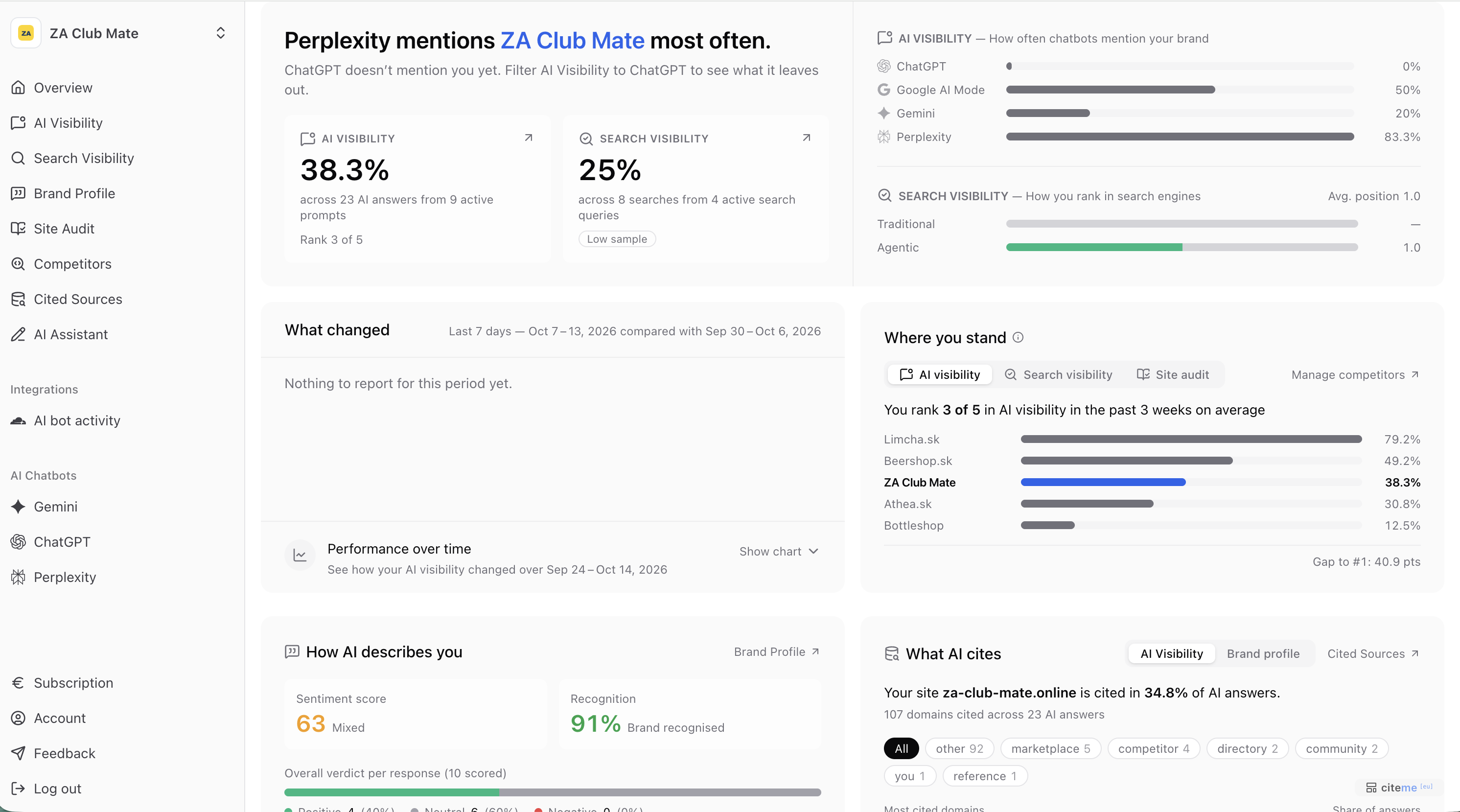
Not a dashboard full of numbers. A sentence that tells you what's happening.
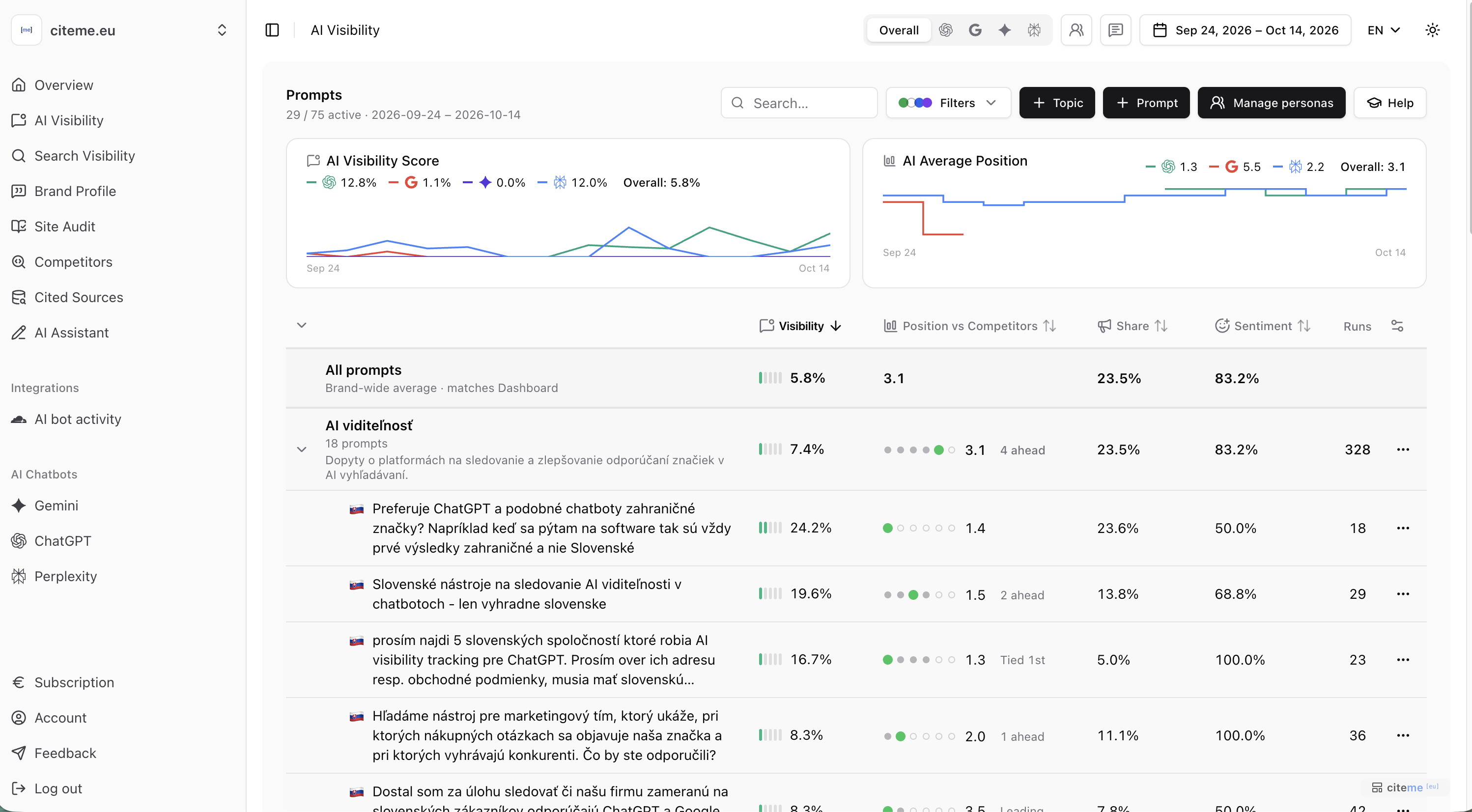
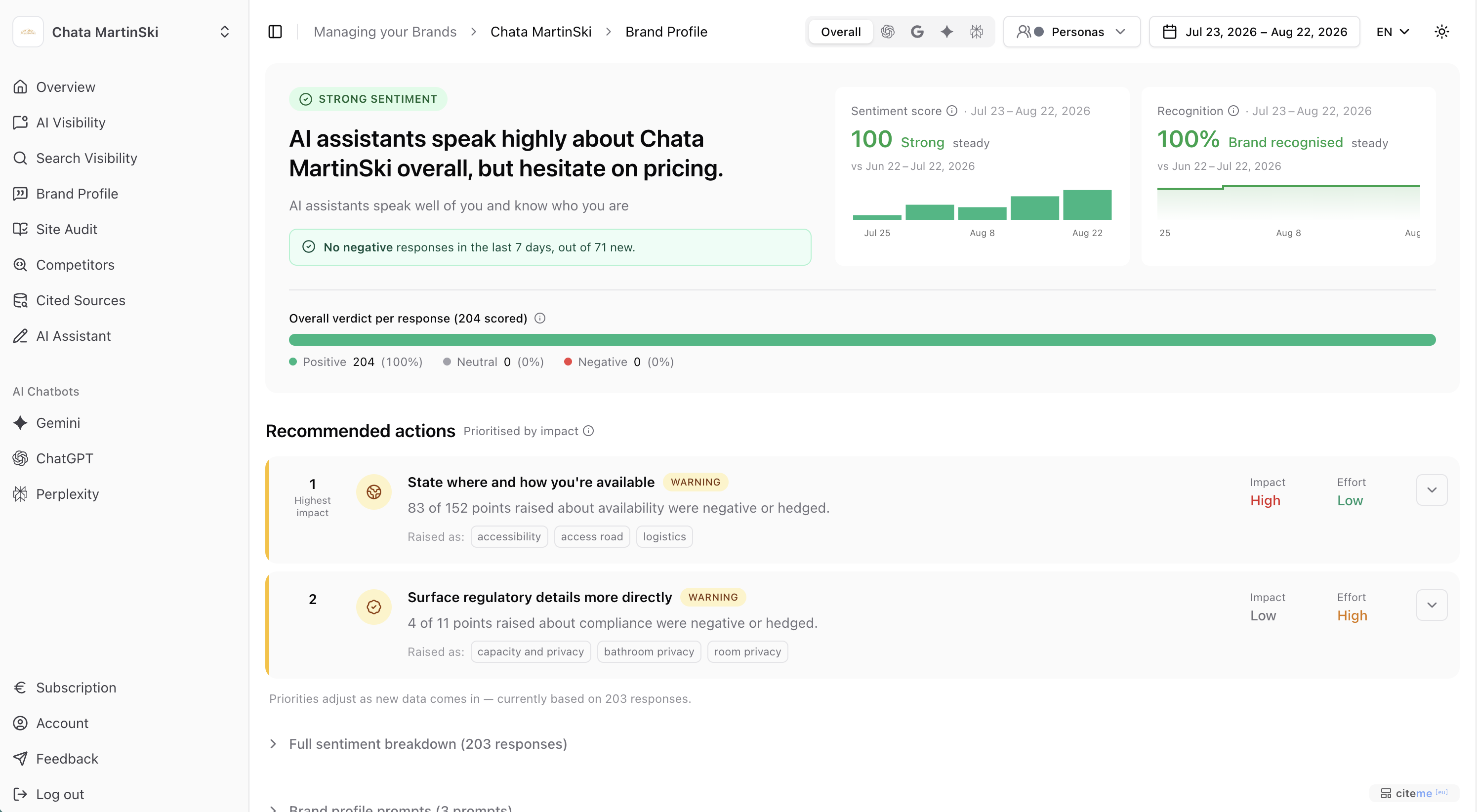
We didn't remove the numbers — we moved them to second place. Every screen starts with a finding in plain language and ends with a specific step ranked by impact and effort. Even if you open the platform once a week for five minutes, you know what to do.
AI visibility score: 27.2
- —A metric without context — is that high or low?
- —You have to interpret it yourself
- —No action step follows from the number
- —You stop opening it after the third week
- —You can't ask ChatGPT or Claude about the numbers directly
“AI mentions you more and more often — but usually only behind direct competitors.”
- →Important findings right at the top, in plain language and with context
- →Below that, the reason and numbers as proof that it's not just a feeling
- →Followed by options on what to do about it
- →Everything sorted by impact, not by volume
- →Connect your AI assistant (MCP) and ask ChatGPT or Claude about the results

An easy start for marketing teams and small websites alike.
Deployment takes minutes and requires no changes to your website or code. Just your domain is enough.
Enter your domain
We automatically deduce what industry you are in, who your competitors are, and recommend prompts—i.e., questions that match customer intent for your products. You can, of course, edit these prompts or add your own.
We run the questions in AI Chatbots
We send all prompts to your chosen chatbots — with exact region and language settings. If you have, e.g., 20 prompts, we get the results for 4 chatbots in one to two minutes.
We evaluate each answer
We determine which companies are mentioned, in what order, and with what sentiment (positive, neutral, negative). We also identify what keywords the AI models used for searching. Finally, we record which websites were used to generate the answers.
You get the first results and recommendations
Based on the results, you can take the first specific steps — we show you the keywords used for searching. You decide which ones to accept, and then we run Classic as well as Agentic searches. While waiting for those results, we'll show you your site audit results — a detailed technical audit included free. It reveals any shortcomings and shows how you compare to the competition.
Results in a readable format
Data summarized in a clear format with a list of recommended steps: e.g., Chatbots answer uncertainly about product availability — update the information on your website. You didn't rank at all in search for the searched keywords — focus your SEO on this area. Your website blocks access for Perplexity — contact your website operator, etc.
[ NEW ] AI WEBSITES
Need a new website? We'll build it ready for AI.
A fast, good-looking website for businesses in Slovakia and the EU, with technical SEO, structured data and AI bot access. Fixed price from 790 €, delivered in 2 weeks, with citeme.eu credit included.
Pay only for what you track
Most platforms lock you into fixed plans regardless of how much you use. The detailed technical audit is free; you pay for tracking, the AI assistant, and related features. Adjust the sliders to match your monitoring needs — the price updates instantly.
Monthly price
20,00 €
billed monthly
- ✓14-day money-back guarantee
- ✓AI visibility dashboard
- ✓Competitor benchmarking
- ✓Region/language selection
- ✓Sentiment analysis
- ✓Optimization recommendations
- ✓Detailed technical site audit — free (your site and competitors')
- ✓AI model source tracking
- ✓Connect your AI assistant (MCP) — ChatGPT and Claude
Payments secured by Stripe
Cancel at end of billing month · Upgrades take effect instantly
Frequently asked questions
Chatbots, AI models and assistants, as well as LLMs are synonymous in our context. All these terms refer to a language model capable of answering questions and generating text. AI agents are a specific way of using an AI model, where based on input, they create complex actions like web searching, interpreting results, calling tools, and so on.
Do you remember chatbot hallucinations and their outdated answers? For instance, when you asked for the results of a football match, and ChatGPT replied that its data only goes up to 2024. Companies like OpenAI and Google solved this by having models stop answering solely from memory (i.e., information available at the time of training) and instead fetch fresh results from the internet. That's why at citeme.eu we don't treat these 3 types as separate — you get into an AI answer either because the search engine found you directly or via a third-party site mentioning you. The interconnection also applies to agentic search: e.g., Tavily explicitly states that where Googlebot can't reach, their crawler won't either. Despite this, competitor tools often measure them separately — in a second subscription, with a different methodology, and for a different time period. citeme.eu tracks all three layers at once, for the same period, and the results are then summarized on one page: where you are strong, where you lag behind, and where the information actually comes from.
The name prompts comes from the English word prompt, which means a cue or trigger, not exactly questions. In our context of AI search, a prompt is a question you ask the AI model. For example, a prompt could be: "What is the best HR software for a 50-person team?" or "Alternatives to BambooHR".
Your brand profile is monitored by a group of special prompts (questions) that directly ask about your brand, products, or services. For example, "What do you know about the brand citeme.eu?" or "Would you recommend citeme.eu to me?". Based on these prompts, we determine whether the AI model even knows you, what sources it draws from when looking for answers, and importantly, what the sentiment of the answer is (positive, critical, or neutral). We automatically suggest these prompts at the beginning, but you can also edit or create them yourself. On app.citeme.eu, we automatically show you warnings if, for example, negative reviews appear, and we point to their sources.
The audit of your website consists of two parts: technical and content. The technical part reveals, for example, whether your site blocks access for AI models (e.g., via Cloudflare or robots.txt), whether it complies with SEO standards like loading speed, use of JSON-LD schema, and similar. The content part focuses on the quality and relevance of the content itself. This means whether the page provides unique and useful content. Specifically, we evaluate originality, clarity, verifiability, and whether the content is aimed at readability for humans (not bots). The technical audit is free — a detailed check of your site with no paid plan required. Paid plans cover tracking, the AI assistant, and related features. The content audit is part of the AI assistant (5× in the lowest package). Based on the audit, you will receive specific recommendations to help you improve visibility in AI answers.
The honest answer is that it depends on the category and how competitive your market is. But from our experience, we can say it takes weeks before AI answers start reacting to content changes on your website. However, there are also situations where our audit identified critical errors in the website that blocked access for AI models (specifically via Cloudflare) — such changes bring results within days.
The absolute minimum (€20/month) includes one AI model (plus search engines). But we recommend starting with all four, plus 30 prompts (questions) for €69.30 per month. The advantage is that you cover the most frequently used platforms (ChatGPT is still the most popular, but the popularity of Google AI Mode and Gemini is growing quickly), but you also get an excellent overview of where AI draws data from and what keywords it uses to search.
No. citeme.eu is an independent local tool for modern SEO. It has no connection with other foreign services with a similar name.