AI search queries
The web searches assistants run while answering your prompts, and how to turn them into tracked search queries.
When an AI chatbot answers a prompt, it may search the web first. Asked "best HR software for a 50-person team", that can be "HR software small business", "BambooHR alternatives 2026" or "HRIS pricing comparison". We call those searches AI search queries.
Where to find them
- On an answer — the searches the chatbot ran while writing that answer. Not every answer includes a search, though: when the chatbot already knows the answer, as with "Who invented Coca-Cola?", it often answers without searching the web.
- On Search Visibility — AI search queries from all your prompts in one table, with how often and which chatbots used them, and results for the ones you already track. Open the table by clicking the X AI search queries tile. See Search Visibility.
- On a prompt's detail page — every AI search query issued for that prompt, and suggestions to track.
Intent labels
Each AI search query has an Intent label. The intent shows what the chatbot was actually doing when it searched: comparing offers, checking prices and reviews, or going straight for a specific brand or website. That tells you at which stage of the buying decision the answer is formed and what content the chatbot should find on the web. The names match the app:
| Intent | What the chatbot searched for |
|---|---|
| Comparison / list | A ranked list or a head-to-head |
| Pricing & buying | Prices, plans or buying |
| Category (unbranded) | The category name without a brand |
| Reviews & reputation | Reviews, ratings or trustworthiness |
| Informational | A how, what or why question |
| Your brand | Your brand name, for example "Acme pricing" |
| Competitor | A competitor's name |
| Other entity | Another company, person or organisation |
| Technical probe | A technical request aimed at a specific website — a search operator such as site:acme.com pricing, or a pasted URL. The chatbot already knows which site it wants to read and isn't choosing a vendor |
| Other | None of the above |
You can change a label by hand. It then applies everywhere the same query appears for the brand.
Language
Each AI search query also shows the language it was actually written in. That is not always the language of the market the prompt targets. When they differ, the app says the brand is competing in a language other than the one it publishes in.
Why it matters: if you are a Slovak brand and the chatbots search in English even for Slovak prompts, your Slovak pages won't turn up in those searches and the answer is built from English sources. That's when it pays to publish your content in English too. More in Why Slovak companies have a harder time in AI search.
From AI search query to tracked search query
An AI search query becomes a suggestion once a chatbot has used it in more than one answer. Accept a suggestion to start tracking it as a search query: choose the topic it belongs to (we pre-select the topic its prompts already use), and it starts running straight away and stays linked to the prompts that issued it.
Some queries are shown but not suggested: search operators, pasted URLs, queries that are too short or too long, and your own brand name or domain. You can still track any of them.
Link to search visibility
A tracked AI search query stays linked to the prompts it came from. That shows you what role SEO plays for a given prompt: whether AI cites sites because they rank well in search, or independently of it.
You find it on a prompt's detail page, on the Cited sources tab. For each cited domain, the AI / Search column compares how often AI cites it with its average position in the linked searches:
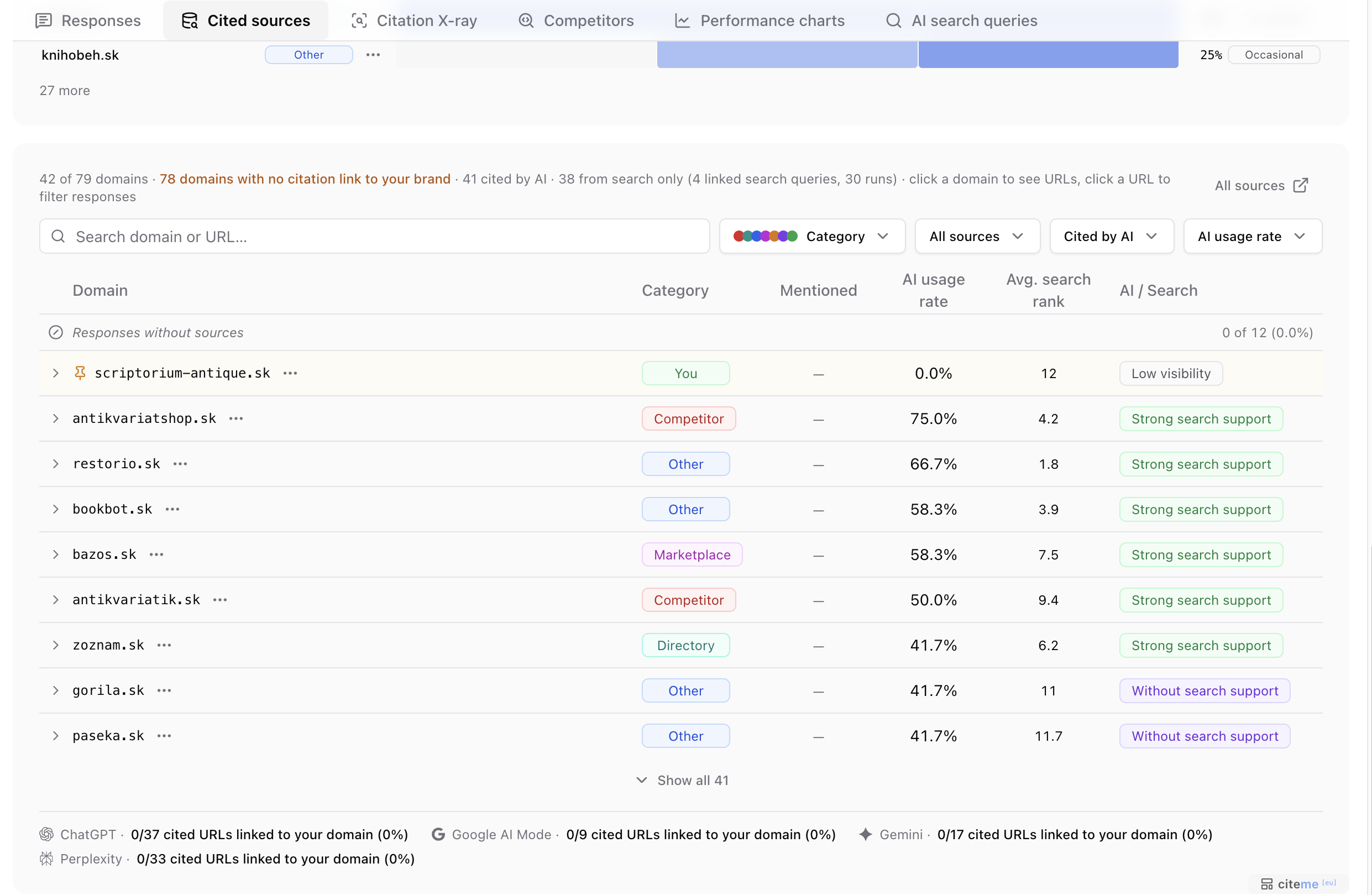 The Cited sources tab on a prompt's detail page
In the example, AI cites antikvariatshop.sk in 75% of answers and it ranks around 4th in search — Strong search support: a better search position directly helps it get cited here. gorila.sk, on the other hand, is cited in 41.7% of answers even though it isn't in the top 10 in search — Without search support. The exact rules are in AI citations vs search rankings.
This link is unique to citeme.eu: we combine AI chatbot answers with traditional and agentic search results in one tool, so you see not only whether AI cites you, but why.