Why Slovak companies have a harder time in AI search
If you sell software in Slovakia, to Slovak customers, in Slovak, you might assume that global competition is somebody else's problem. Our data says the opposite: when an AI model answers a Slovak question about your category, it usually goes looking for the answer in English.
What we measured
Between June and August 2026 we recorded 9,982 AI model responses to questions asked in Slovak (in Slovakia) across sectors — FinTech, SaaS startups, small e-shops, law firms and local businesses. For almost every response, models like ChatGPT, Gemini and Perplexity first go out to the web for information, through so-called fan-out queries, which are essentially long keywords.
A Slovak question, an English route to the answer
A fan-out query is a search the model writes for itself — not what the user typed. If you ask which invoicing software is best for a sole trader, the model does not search that sentence. It breaks the intent down into several longer, more specific queries — and it chooses the language of those queries based on where it expects the best material to be.
Here are a few concrete examples from our database:
„čo sa oplatí na prijímanie online platieb pre startup“
- en
best payment gateway for startup 2025 Europe - en
online payment methods for startups low fees
„kde kúpiť zberateľské a staršie knihy online“
- en
AbeBooks rare books antiquarian books official - sk
Slovensko online antikvariát staré zberateľské knihy
„najlepšie chaty pre skupinový pobyt pri lyžiarskom svahu“
- sk
najlepšie chaty pre skupinový pobyt pri lyžiarskom svahu Slovensko - sk
chaty na prenájom pri lyžiarskom stredisku Slovensko pre skupiny
Software and technology companies have it hardest
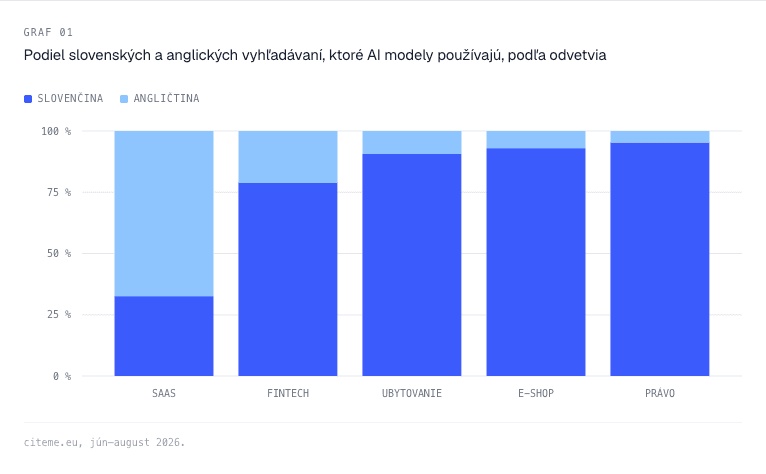
The differences between sectors are larger than any single headline number suggests. Law firms, e-shops and accommodation are answered almost entirely from Slovak sources. FinTech sits somewhere in the middle. SaaS is the exception — the only sector where English sources outnumber Slovak ones.
Share of Slovak and English searches AI models use, by sector
In the worst-affected sectors, as many as two thirds of the fan-out queries (keywords) behind a Slovak answer are in English.
For e-shops, accommodation and local businesses, AI models rarely use English words to search.
What this means for a company
The practical consequence is that your competition inside AI answers is not the one you planned for. You may have three Slovak competitors and set your prices against them. A model searching in English compares you with the global leaders of the category — and often against a list you are not on at all.
It also explains a pattern we see constantly: a company ranks respectably in Google for its Slovak keywords, and in ChatGPT it is almost invisible for the same question. These are two different search problems, and solving the first does not solve the second.
What to do about it
The first step is knowing which of your topics are already being answered in English and which are not. That is exactly what citeme.eu measures — per prompt, per model, per language.
- Publish content about your category in English too. But if your target market is Slovakia, always make it clear that this is a product for Slovakia. Comparisons, integration documentation, pricing explanations and use-case pages — this is precisely what fan-out queries pull up. An English version with no clear local signal, however, throws you in with the global players, where the competition is incomparably larger. State the country you operate in, the currency, local support and local legislation — it narrows the set the model compares you against.
- Where it is possible (though usually demanding), get into the English sources that AI models cite. You will find them in app.citeme.eu for every response.
Some Slovak companies are already responding to this shift and are moving content production almost entirely to English — Dalibor Cicman of GymBeam talks about it on Tomáš Braverman's podcast, for example. It is a legitimate route, it just has its price: the less you signal that you are a Slovak product, the wider the competition you take on.
At the same time, expect this to change. Models are getting better at localisation and will likely search directly in the user's language more and more often. The differences are visible already — Gemini generates markedly fewer English queries than ChatGPT.