How ready are Slovak websites for AI search?
The most critical problem is blocked access for AI bots, and the most common shortcoming is missing or incorrect structured data. Otherwise Slovak and international pages are at the same level of readiness. That follows from an analysis of 15,143 pages checked by citeme.eu.
What we measured, and on which pages
How we picked the pages: the address of every page comes from citations by AI models — ChatGPT, Gemini, Google AI Mode and Perplexity (we analysed 9,982 responses to questions across a range of sectors).
How we tested them: this is a technical citeme.eu audit, aimed at technical rather than content readiness. The checks follow the webmaster guidance from Google Search Central and Bing's webmaster guidelines, plus a handful of rules of our own.
What the score means: every page gets a citeme.eu score out of 100 — our own internal metric. What matters more is that every technical shortcoming is sorted into categories matching the Google and Bing guidance above.
When we collected it and on what sample: between 20 June and 21 August 2026 that came to 3,237 cited pages across 1,582 Slovak (.sk) sites and 11,906 cited pages across 5,422 sites elsewhere in the world. These are pages, not sites — one site usually contributes several pages to the analysis. Pages that scored zero, the ones we could not reach at all, are excluded from the figures below. The reason is that pages which no longer exist should not drag the whole group's average down.
Slovakia vs. the rest of the world — a draw
Slovak pages average 66.8. The rest of the world averages 67.6. That is a gap of 0.8 points — on a 0–100 scale, all but negligible. More interesting than the gap between the groups is the level itself: neither of them is anywhere near the ceiling.
Average citeme.eu score, Slovak pages against the rest of the world
What fails most often on Slovak pages
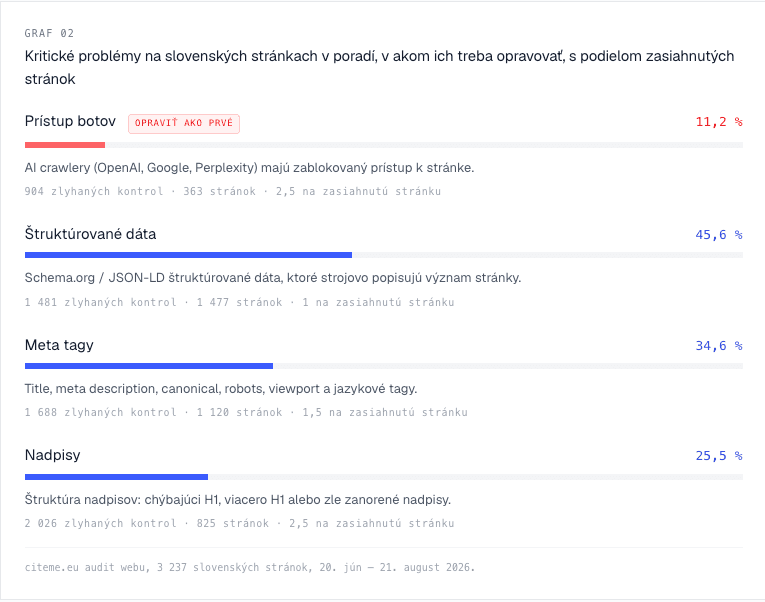
Across the 3,237 Slovak pages the audit raised 6,099 critical findings — 1.9 per page on average — in four categories. They are listed below in the order they need fixing, not by how many pages each affects.
Critical issues on Slovak pages, in fix-first order, with the share of pages affected
AI crawlers (OpenAI, Google, Perplexity) blocked from fetching the page.
904 failed checks · 363 pages · 2.5 per affected page
Schema.org / JSON-LD structured data for machine-readable page meaning.
1,481 failed checks · 1,477 pages · 1 per affected page
Title, meta description, canonical, robots, viewport and language tags.
1,688 failed checks · 1,120 pages · 1.5 per affected page
Heading structure: missing H1, duplicate H1s, or poorly nested headings.
2,026 failed checks · 825 pages · 2.5 per affected page
We treat blocked bot access as a critical problem, because it means an AI crawler — OpenAI, Google or Perplexity — has its access to the page blocked.
With bot blocking it is worth pointing out that the 11.2 % above is a share of pages, not of sites. The blocking itself is usually configured for a whole site, either through the robots.txt file or through WAF rules / bot management (in Cloudflare, for example). Seen that way, 137 of 1,582 Slovak sites block at least one analysed page, or 8.7 %.
And not every block is a mistake. The sites that block tend to include news portals, booking services and classifieds, for which restricting AI crawlers is a deliberate decision. What that looks like in practice is shown by the robots.txt on appforge.sk, which at the time of this analysis lets search crawlers through freely — the group for all bots is Allow: / — and names AI crawlers individually to disallow them, among them GPTBot, Google-Extended, ClaudeBot, CCBot and Bytespider. The header spells it out too: search=yes, ai-train=no. So it is always worth deciding whether the same kind of block makes sense for you.
Where to start
In the order we would fix them — bot access always first:
- Unblock the AI crawlers. Check robots.txt as well as the WAF and bot-protection rules, for crawlers such as OpenAI's and Perplexity's.
- Add structured data. By far the most common failure, and usually a single missing block per page — whichever type matches the page: organisation, product, article, FAQ.
- Fix the meta tags. 1,120 Slovak pages have at least one problem with a title, description, canonical, robots, viewport or language tag.
- Give every page one H1 and a heading tree that nests. The 825 affected pages average 2.5 problems each, which is what a shared template usually looks like — fix the template, fix many pages at once.
citeme.eu runs exactly this technical audit on your own site and reports every failed check next to the page it came from. The technical audit is free — you get a detailed check of your site with no paid plan required. Paid plans cover tracking, the AI assistant, and related features. What we did not assess in this article is the content audit, which our AI assistant handles — 5× included in the price of every plan.
If you want a website that passes these checks from launch day, see our web design for AI and SEO. We guarantee a score of at least 90/100 in our audit.