How to measure AI visibility properly
Measuring AI visibility shows how often ChatGPT, Gemini or Perplexity mention your company. You also see where they place it, how they describe it and who they name before you. And you track the sources AI draws on. That tells you where your brand stands and what to work on first.
This guide shows how to set up the measurement, which metrics to track and how to use them when you change your website and company profiles.
What to track when measuring AI visibility
Good measurement looks at how often the brand appears, where AI places it, how it describes it and which sources it draws on. In citeme.eu these metrics and views cover it:
| What you track | What it tells you |
|---|---|
| Brand mention and AI visibility | How often AI mentions our company: the share of answers with a mention. |
| Average position | How early AI names us: the order among brands in answers that mention you and where the order can be determined. |
| Sentiment | How positively or negatively AI describes us. Read it together with position and how regularly you appear. |
| Share of voice | How many other brands we share attention with. Counted in answers that mention you; the brands in an answer split the attention equally. |
| Cited sources | Which web sources AI used for the answer, including ones the answer does not show as a link: your own pages and external sites, by domain and by exact URL. Your site appearing here is not the same as a brand mention. You can also track which sources keep coming back across answers and days. |
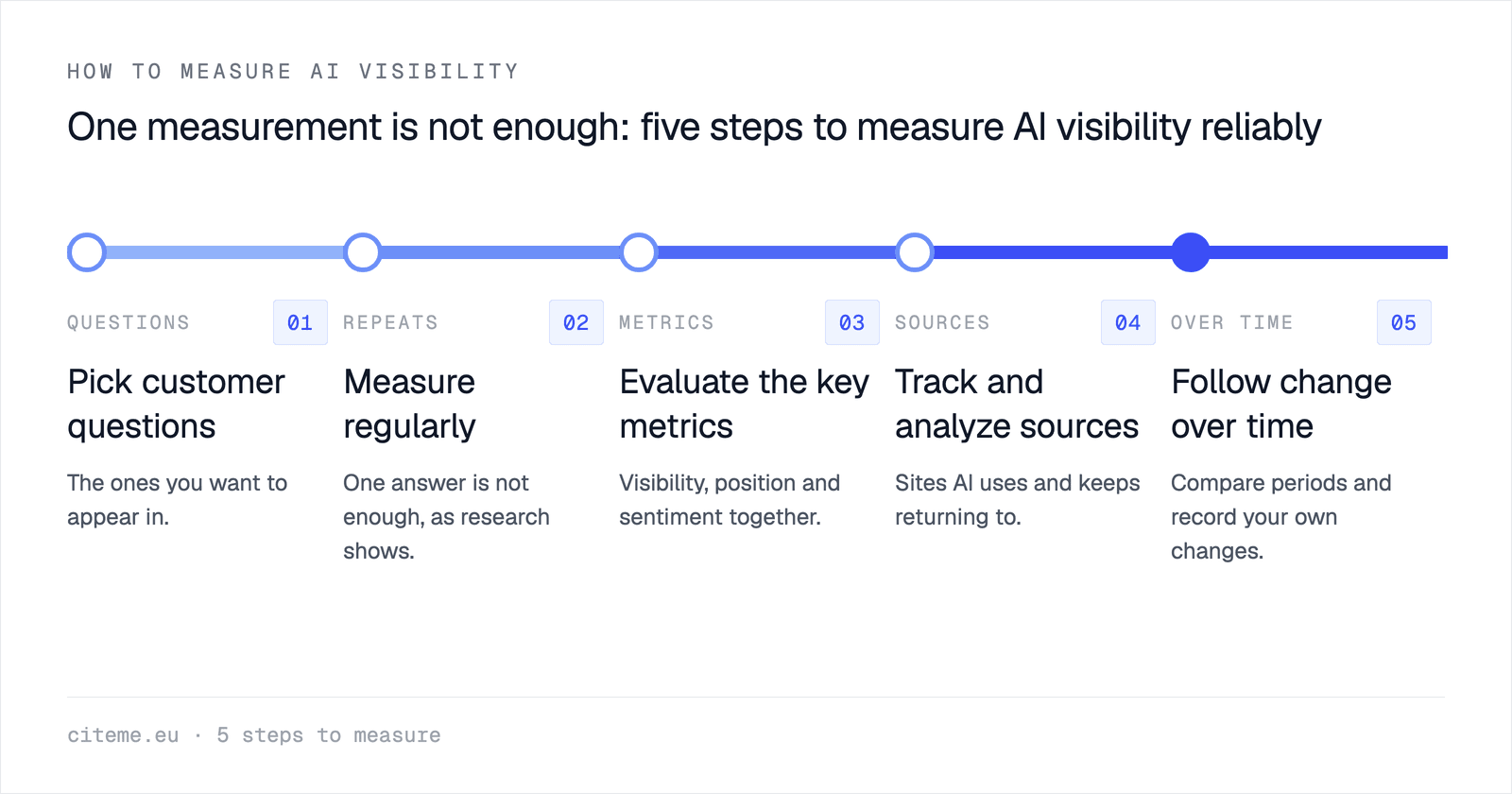
Five steps show how to measure them. For most you get the manual method next to how it works in citeme.eu.
1. Pick the questions customers ask before buying
Start with questions where it makes sense for your company to appear among the options. For example:
- “Which agency runs management training in Slovakia?”
- “What invoicing software suits a small company?”
- “Where can I buy antique porcelain online?”
Split the questions by offer, customer needs and market. Track an important service separately so its result does not get lost in a company-wide total.
Questions directly about your brand, such as “What do you know about our company?”, are a separate category. They do not measure AI visibility but check how AI describes you. In citeme.eu you find them on the How AI describes you page. For AI visibility, use questions without the brand name: they show whether a customer discovers you without knowing your name.
2. Measure regularly and show how many answers are behind the number
The same prompt can bring different sources every time you run it, so one measurement is not enough. The authors of Understanding ChatGPT Citations tested the same 80 English and Chinese questions on two ChatGPT settings (5.3 and 5.5 Instant), each question 20 times. Of all unique URLs found during search, 40.8% in one setting and 44.5% in the other appeared in only one run. These numbers describe candidate pages that were found. Agreement between runs was higher for site hostnames than for exact URLs.
What we see in our own data
We ran the same comparison on the answers citeme.eu collects. We took 220 prompt + AI model pairs with at least 20 answers that have sources (6,120 answers to 124 prompts, 5 AI models). For each pair we counted how many sources on the answer’s source list appeared in only one answer.
Pages found in the study and sources used in our data that appeared in only one run when a prompt was repeated
| What is compared | Study: pages found (ChatGPT 5.3 / 5.5) | citeme.eu: sources used |
|---|---|---|
| URLs that appeared in only one run | 40.8% / 44.5% | 47.8% |
| Domains that appeared in only one run | not reported | 39.5% |
A lower share in only one run means more stable sources. The study column is pages found during search; the citeme.eu column is sources used in the answer.
The numbers are not directly comparable, though. Our answers are collected spread over time (a median of 50 days between the first and last answer of a pair), so they also reflect websites and AI changing over time. The collection method and the chatbots differ too. The study counts pages ChatGPT found while searching; we count the sources on the list the chatbot gives with its answer.
The direction is the same: domains repeat more reliably than exact URLs. In our data 47.8% of URLs appeared in only one answer, against 39.5% of domains. So two answers to the same prompt mostly cite different pages, but more often the same sites. A domain was more stable than a URL in 194 of 220 pairs, and for every AI model on its own. For URLs the study reports similar numbers, although it measures something slightly different, and for domains (site hostnames) it reports higher agreement than for URLs.
What to record for every answer
For every answer, save the exact wording of the question, the date, the language, the country and the chatbot used. If the model or mode is available, record that too.
When measuring by hand, do not use your everyday account and browser. A chatbot remembers your earlier questions and adapts its answers to them. If you ask the same question for 20 days in a row through your own subscription, you will get similar, biased answers. Switch between browsers or use fresh sessions without logging in, and note the personalisation settings.
Compare periods under the same conditions and with the same mix of questions. Note any change of model, schedule or prompt list in the report.
If you can, also record the search queries the chatbot ran while answering (known as query fan-out). It is not essential, but they show which words AI searches for. You can read more in the docs on AI search queries and in check 6 of the article How to improve your brand’s AI search visibility.
How to calculate the share of answers
For one chatbot and the same set of questions, you can express basic visibility like this:
An illustrative example: if one chatbot mentions you in 12 of 40 answers, the share is 30%. In the report write “30% — 12 of 40 answers”. That makes it clear at once how many observations the number comes from.
Add the number of failed measurements to the working report too. A failure to get an answer is not an answer that did not mention the brand.
3. Read AI visibility, position and sentiment together
Order can influence which option a user picks. In experiments with ChatGPT recommendations, Hong and Kim (2026) examined whether people process these recommendations quickly or compare them carefully. Decision-time evidence pointed to quick, position-based processing, where people treat the first item as the best one, rather than to comparing the attributes of each option. An early placement can therefore act as a signal of quality.
Research on how people read the web points the same way. In a Nielsen Norman Group (2018) study, more than 42% of the time people spent viewing an ordinary web page fell within its top 20%. These are web pages, not AI answers, but the result warns that a mention deep in the text gets less attention.
Position alone does not say how a brand is judged. In an experiment with 470 participants, Ketelaar et al. (2015) looked at how the tone of an online review affects purchase intention, and its strength depended on the reader’s expertise. The results concern product reviews, not AI answers, but they support tracking whether the assessment is favourable or unfavourable.
That is why we recommend evaluating position and sentiment together when measuring AI visibility. A positive mention at the start of an answer and an early warning against a brand mean different things when you interpret them. Both situations deserve attention.
In citeme.eu, track AI visibility, average position and sentiment together. In individual answers, also look at the context: whether AI recommends the brand, merely lists it among options or points out its drawbacks. In the saved answers you can also see the questions where a competitor was named ahead of you.
4. Find out which sites AI draws on and which keep coming back
Sources are the hardest thing to collect by hand, so in citeme.eu you track them right on each prompt. The prompt detail has an overview called “How many and which sources keep showing up in answers?”. The chart shows how it developed day by day, the colour-coded table below it how often each source appears, and a label next to each domain says whether it is your site, a competitor or a directory. The Domain / URL switch changes the level of the view.
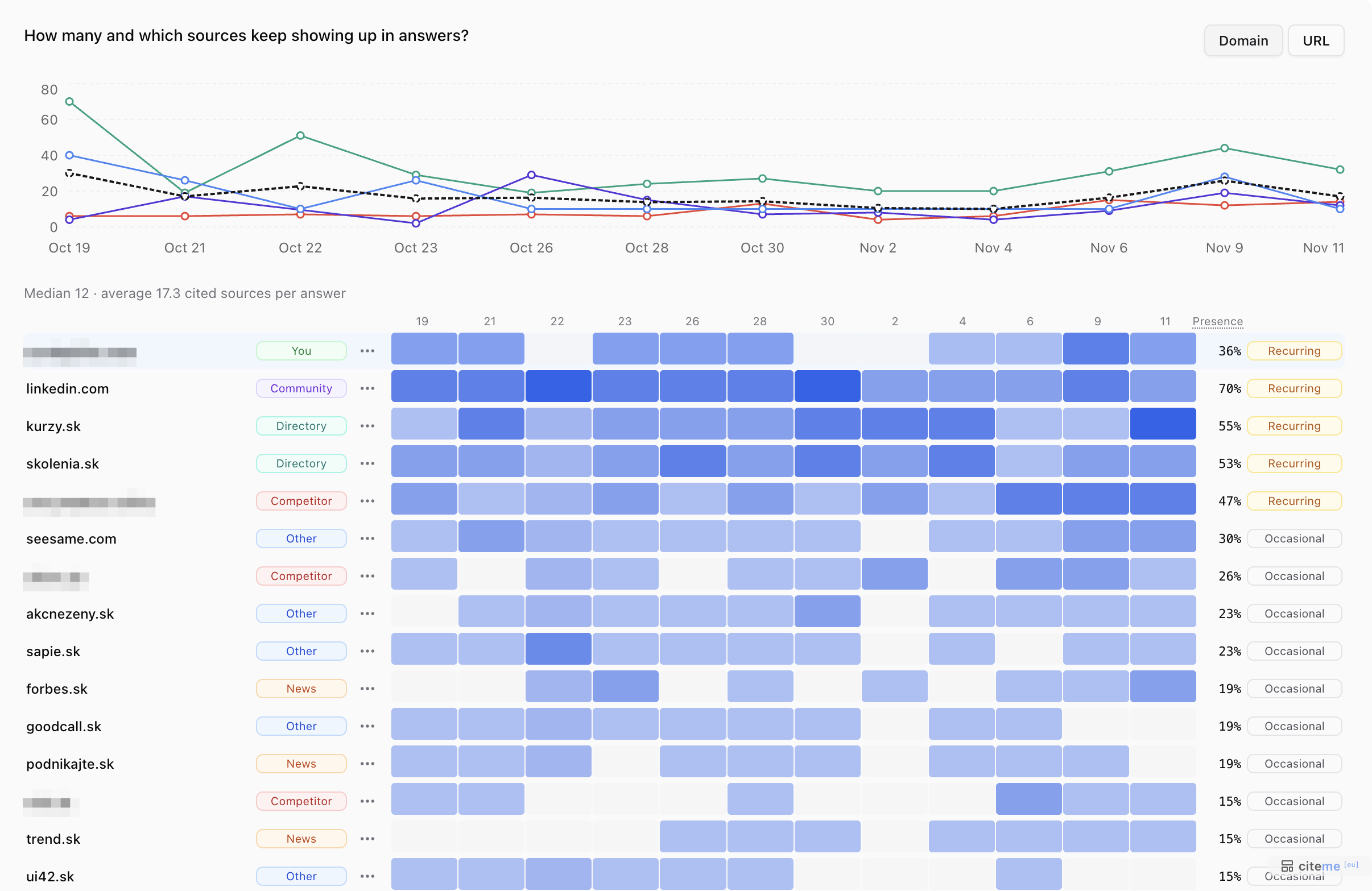
When reading the overview, work from the question to the source:
- Choose a tracked prompt and a period.
- Check whether your domain returns across several measurements.
- Switch to URL and check which subpages are behind the appearances.
- Open the answers where a competitor or another source appeared.
This gives you concrete tasks: check your own page, fill in the information in a directory or read the comparison that does not mention you. We write about choosing relevant external platforms in the article Where is it worth being for AI to find you?
5. Follow change over time
Compare the same questions and chatbots in the following periods too. You see whether visibility is growing, fluctuating or falling. If you changed something on your website, note it in a simple list: a page edit, a new article, a completed company profile or a fixed website availability problem.
If the share of mentions goes up, check how many answers are behind it, which topics it concerns and whether the growth shows across several chatbots. Compare their results separately too.
Evaluate changes together with the original answers, the measurement conditions and how things developed after the intervention. That shows you which topics your position is improving on and where to keep working.
If the measurement shows that AI leaves you out, start with the checks in How to improve your brand’s AI search visibility: 8 checks to start with.
Frequently asked questions about measuring AI visibility
How many times and how often should I measure AI visibility?
There is no exact number. One measurement is not enough, and the spread over time matters as much as the number of repetitions: models evolve and competitors keep publishing new articles, so a result from one week may not hold a month later. Measure the same questions and chatbots regularly, state the number of answers behind each result and read smaller samples with caution.
Why does AI answer the same question differently every time?
A chatbot builds each answer from scratch and may search the web and pick different sources on every run. A single answer therefore proves little. In our data, for the same prompt, almost half of the URLs appeared in only one answer, while domains repeated more reliably. Track the share across all answers, not individual answers.
What should I do when AI does not mention us?
The measurement shows where AI leaves you out, so start there. First check whether AI can reach your website at all and whether it is indexed; the technical website audit, which is free in citeme.eu, shows that. You find further steps in the article How to improve your brand’s AI search visibility: 8 checks to start with.
Start measuring your AI visibility
The easiest way to begin is the technical website audit, which is free in citeme.eu: it shows whether AI can reach your website at all. To track mentions, position, sentiment and sources, you can set the price to your needs: the number of prompts, how often you measure and the AI models. Besides the answers of AI chatbots, we also track visibility in search engines. You can start right away.